
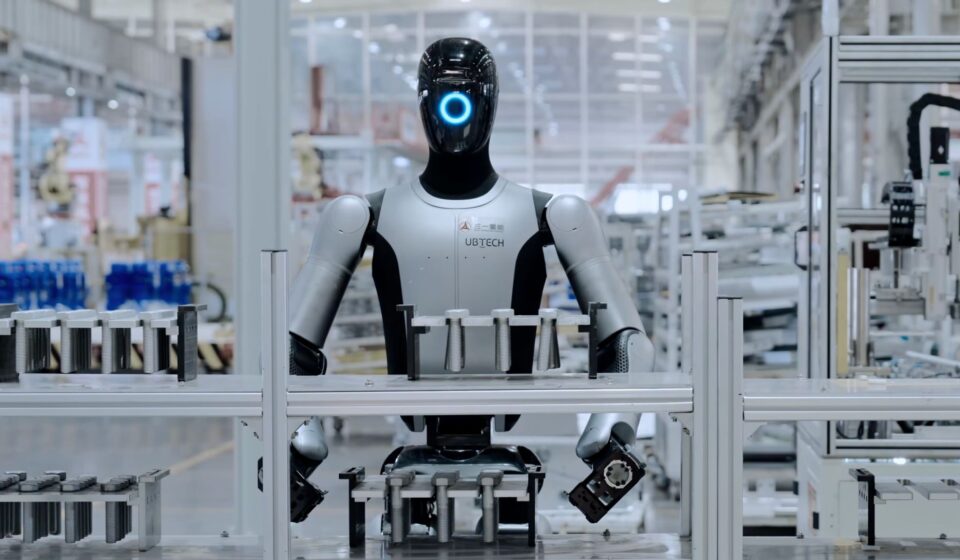
At China’s first 5G-enabled wind power smart factory, UBTECH’s Walker S2 humanoid robots are demonstrating how advanced robotics is reshaping industrial production.
From precise component sorting to adaptive manipulation, the system showcases the role of intelligent, flexible automation in clean energy manufacturing.
The deployment highlights how 5G connectivity and humanoid robots are accelerating efficiency and autonomy on the factory floor.
In December, the Chinese robotics firm reached a significant milestone, rolling out its 1,000th Walker S2 humanoid robot from its Liuzhou manufacturing facility.
Smart factory humanoid
The video shows a humanoid robot operating inside a 5G-enabled smart factory run by SANY RE, a manufacturer of wind power equipment in China.
The robot moves autonomously through the industrial environment, walking between workstations and navigating the factory floor without human assistance. As it works, it performs a range of production tasks that mimic human actions, including the precise handling of components and adaptive manipulation on the assembly line.
Throughout the footage, the robot demonstrates controlled, dexterous movement and stable balance. It steps over floor markings, adjusts its posture in real time, and responds smoothly to changes in its surroundings, highlighting its ability to operate safely and effectively in a shared workspace.
The combination of mobility, fine motor control, and 5G connectivity underscores the robot’s role as a flexible industrial worker.
According to experts, the video demonstrates how humanoid robots can support modern automated manufacturing by blending human-like movement with intelligent, connected systems.
A few days ago, UBTech signed a new agreement with European aviation giant Airbus to supply robots for use in aircraft manufacturing facilities. As part of the deal, Airbus has purchased UBTech’s Walker S2 humanoid robot and will collaborate with the company to assess how humanoid systems can assist with aircraft manufacturing tasks.
The Airbus agreement follows a similar partnership signed last month with Texas Instruments, a US semiconductor firm. According to reports, Texas Instruments has been deploying and testing the Walker S2 humanoid robot on its production lines.
Autonomous industrial humanoid
UBTech states that the Walker S2 humanoid robot is designed around a whole-body, human-like dynamic balance algorithm, enabling it to perform physically demanding tasks while maintaining stability.
The system allows deep squatting, forward pitching up to 125 degrees, and stable lifting of payloads up to 33 pounds (15 kilograms) within a working range of 0 to 1.8 meters. These capabilities support actions such as stoop lifting, material handling, and precise object manipulation in industrial environments.
Perception is handled by a self-developed “human-eye” binocular stereo vision system integrated into the robot’s head. Using pure RGB cameras combined with deep learning–based stereo depth estimation, the system generates high-precision, real-time depth maps. This provides accurate spatial awareness, reliable object recognition, and safe interaction in dynamic settings.
To manage complex tasks, Walker S2 operates on UBTech’s self-developed Co-Agent system, part of the BrainNet 2.0 dual-loop AI architecture. This framework combines task-driven decision-making with continuous feedback, enabling adaptive behavior, multi-step task execution, and coordinated work alongside other robots.
The robot also features an autonomous power system with real-time battery monitoring and energy management. Its dual-battery architecture supports intelligent switching between charging and automatic battery swapping, enabling long-duration, uninterrupted operation in industrial, logistics, and service applications.