
Chinese scientists have developed an artificial nerve that could teach robots to “feel” pain.

Try Premium Member for Free with a 7-Day Trial
Throughout our bodies are countless tiny sensors known in medicine as nociceptors, or pain receptors. Their job is to detect potential sources of injury and rapidly send warning signals to the brain and spinal cord, protecting us from tissue damage. For decades, scientists have been trying to replicate this biological instinct in electronic devices.
Recently, a research team from Northeast Normal University in China made a significant breakthrough in this field. Reported by Sanjukta Mondal, the team designed a jelly-like artificial pain-sensing neural pathway. At the heart of the device is a tiny electronic component called a memristor. A memristor not only controls the flow of electric current but can also “remember” the amount of charge that has passed through it.
 Recently, the boss of a Chinese humanoid robotics company faced off against his own robot and was kicked to the ground. The video quickly went viral on the internet.
In the past, scientists attempted to build artificial pain sensors using conventional semiconductor technology, but the circuits were extremely complex and bulky, making it difficult to reproduce the subtle gradations of human pain. The emergence of memristors has changed the picture. By exploiting the phenomenon of quantized conductance within the memristor, the researchers enabled electric current to flow in discrete, step-like levels rather than as a smooth, continuous stream. This property allows the artificial sensor to go beyond a simple on/off response and instead distinguish four distinct pain levels—mirroring the human pain scale: no pain, mild pain, moderate pain, and severe pain.
To achieve this precise sensing, the researchers used gelatin films of two different concentrations. A 10 wt.% gelatin film was used in the pressure sensor, while a 1 wt.% gelatin film was used in the memristor. Connecting these two components in series created an artificial nerve. In tests, when mechanical pressure ranging from 9 to 45 kPa was applied, the system accurately detected four different states, from no pain to intense pain.
 Figure a illustrates the process by which humans perceive pain, while Figure b shows Chinese scientists using a pressure sensor and a memristor to experimentally induce pain perception in anesthetized mice.
Another remarkable feature of this biomimetic sensor is its self-healing capability. In experiments, the researchers cut a wound up to 50.7 µm wide into the gelatin sensor. They then applied heat at 60°C for 20 minutes. The results showed that after thermal treatment, the wound completely disappeared and the material’s electrical conductivity returned to its original state. This self-repair ability is crucial for developing flexible electronic devices designed for long-term use.
To demonstrate practical viability, the research team also connected the artificial pain sensor to the sciatic nerve of anesthetized mice. When the sensor was subjected to pressure stimulation, it transmitted electrical signals that directly triggered muscle contraction in the mice, successfully simulating the natural pain-avoidance reflex found in living organisms.
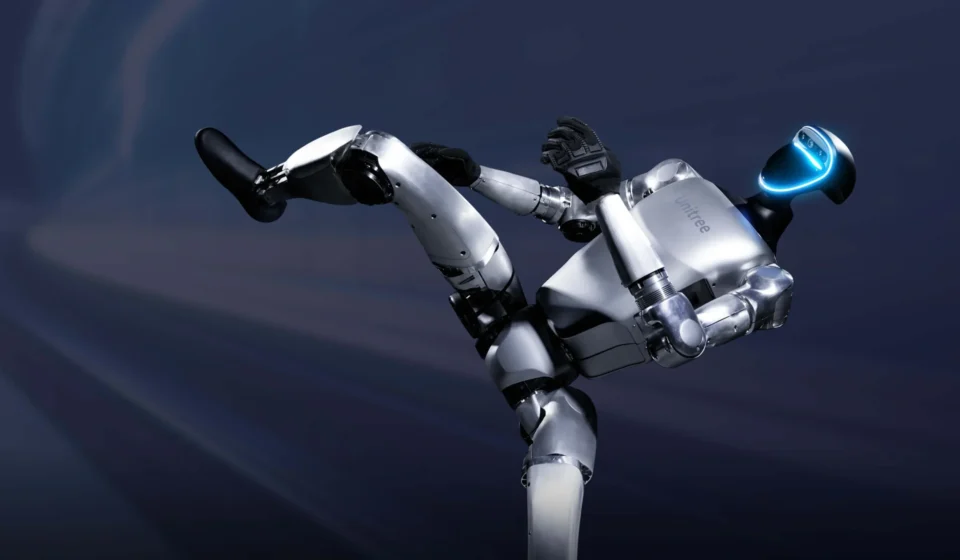
 Unitree’s humanoid robot is already capable of performing flying kicks.
Published by Xuanyu Shan and colleagues in Advanced Functional Materials, this study opens new frontiers for neural prosthetics and intuitive human–machine interaction. This jelly-like new material has the potential to reshape human–machine interfaces and support rehabilitation technologies after injury. As noted by Gaby Clark and Robert Egan during peer review, simulating pain perception is not merely about making machines “feel” pain—it is about equipping future intelligent systems with more realistic sensory abilities and stronger self-protection mechanisms.
Editor: Zhongxiaowen
References