Table Of Content
For years, humanoid robots at CES felt like carefully controlled previews of a distant future. Impressive, but safely confined to prototypes and concept demos. CES 2026 marked a clear break from that pattern. This year, humanoid robots didn’t just pose for cameras or repeat scripted movements. They actually worked.
From factory floors and hospital environments to home kitchens and service desks, companies showcased robots that are already shipping, already deployed, or scheduled for real-world rollout in 2026. What made this shift notable wasn’t just better hardware, but clearer intent.
Defined jobs, commercial customers, and production timelines. Here are the nine humanoid robots at CES 2026 that signaled the transition from experimental machines to practical, deployable co-workers.
Boston Dynamics Atlas
At CES 2026, Boston Dynamics formally introduced the production-ready version of its electric Atlas humanoid, marking the robot’s first public stage appearance. During the keynote, Atlas autonomously rose from a flat position using a non-human joint-flipping maneuver, highlighting the full rotational freedom of its joints before interacting with the audience.
The company also announced a partnership with Google DeepMind to integrate Gemini Robotics AI, enabling Atlas to reason through complex instructions and operate in unstructured environments.
Designed for industrial deployment, the new Atlas features 56 degrees of freedom, a 7.5-foot reach, and a lifting capacity of 110 pounds. It is built for continuous operation, with a 4-hour battery and hot-swappable autonomy. Boston Dynamics confirmed that initial units will be deployed in 2026 at Hyundai’s Metaplant in Georgia, signaling Atlas’s transition from research platform to commercial workforce robot.
Unitree Robotics G1, H2, and R1
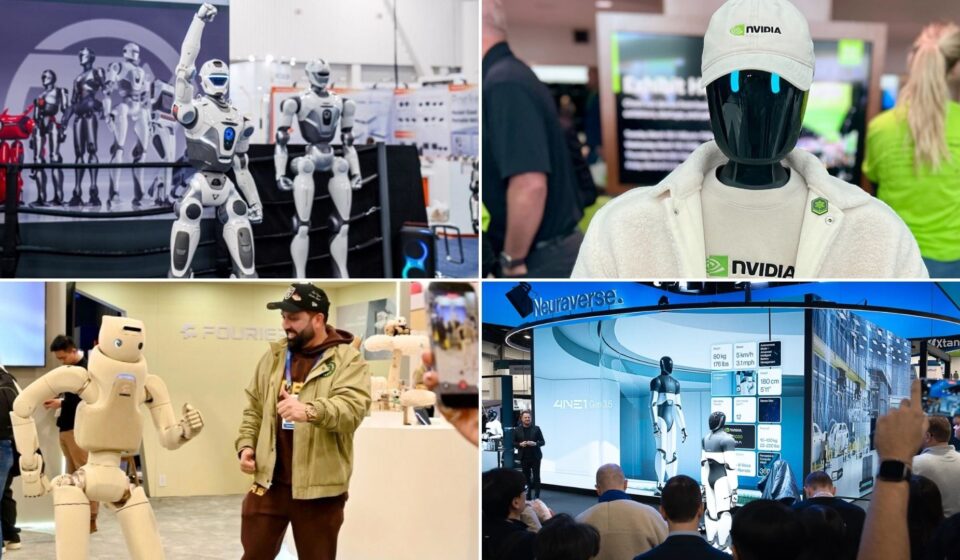
Unitree Robotics showcased its full humanoid lineup at CES 2026, including the G1, H2, and R1, positioning the company as a major player in mass-market humanoid robotics. The G1 drew particular attention through live demonstrations featuring high-speed martial arts and boxing-style movements, emphasizing balance, agility, and motor control. Unitree confirmed that the G1 is designed as a compact, foldable humanoid focused on affordability and scalability, while the larger H2 targets industrial applications.
The company also highlighted its shift toward a Robot-as-a-Service model, indicating readiness for global commercial deployment rather than experimental use. Unitree’s humanoids are powered by its proprietary AI models and feature quick-swappable batteries, depth perception systems, and payload capacities suitable for inspection and manipulation tasks.
LG Electronics CLOiD
LG Electronics debuted CLOiD at CES 2026 as the physical centerpiece of its “Zero Labor Home” vision. Unlike conceptual home robots, CLOiD was demonstrated performing real household tasks in a staged living environment, including folding laundry, loading a dishwasher, and preparing food using standard appliances.
The robot features a wheeled base for stability and a height-adjustable torso that allows it to interact with countertops and cabinets. Its dual arms offer seven degrees of freedom each, paired with five-fingered hands for fine object manipulation. CLOiD is powered by LG’s “Affectionate Intelligence” and a Vision-Language-Action model that allows it to interpret commands, recognize users, and anticipate needs. LG positioned CLOiD as both a physical assistant and a mobile smart home hub, deeply integrated with the company’s ThinQ ecosystem to coordinate other connected devices.
AgiBot A2 Series
At CES 2026, AgiBot officially entered the U.S. market, showcasing the A2 Series at Booth #10715 in the North Hall. This demo came right after AgiBot verified that it has already manufactured and shipped over 5,000 robots globally. Standing 169 cm tall and weighing 69 kg, the A2 was demonstrated in its primary role as a “hospitality helper” in environments such as museums and showrooms.
While the robot possesses a 360-degree sensor suite (LiDAR and HD cameras) for autonomous navigation, on-site reports noted that the CES floor performances were partially human-controlled using a dedicated remote to ensure safety in the crowded booth. Beyond the hardware, AgiBot launched Genie Sim 3.0, an open-source training platform built on NVIDIA Isaac Sim that enables the A2 to learn complex physical tasks, such as movements mirrored from video data, within a digital environment before real-world deployment.
NEURA Robotics 4NE1 (Gen 3)
NEURA Robotics unveiled the third-generation 4NE1 humanoid at CES 2026, presenting a redesigned platform developed in collaboration with Studio F.A. Porsche. The robot was showcased performing both industrial and household-oriented tasks, reflecting NEURA’s goal of building a general-purpose humanoid suitable for shared human environments.
A key focus of the demonstration was the Neuraverse operating system, which allows robots to share learned skills across fleets in real time. Technologically, the Gen 3 4NE1 features high-torque joints, a lifting capacity of up to 100 kilograms, and a patented artificial skin that detects proximity to prevent collisions.
Powered by NVIDIA Isaac GR00T, the robot demonstrated multimodal reasoning through voice, vision, and touch. NEURA positioned the 4NE1 as moving toward series production, bridging industrial automation and domestic assistance.
SwitchBot Onero H1
SwitchBot introduced the Onero H1 at CES 2026, marking its entry into the general-purpose home robotics market. Unlike bipedal humanoids, the Onero H1 uses a wheeled base paired with articulated arms, prioritizing stability and dexterity over walking.
During live demonstrations, the robot performed everyday household tasks such as picking up laundry, opening appliances, and clearing tables. The H1 features 22 degrees of freedom and runs on SwitchBot’s on-device OmniSense Vision-Language-Action model, allowing it to process visual, depth, and tactile data locally without relying on cloud computing.
This enables precise object recognition and manipulation in cluttered environments. SwitchBot positioned the Onero H1 as a practical household assistant rather than a showcase robot, confirming that pre-orders would open following CES as part of its broader smart home automation ecosystem.
LEM Surgical Dynamis
LEM Surgical showcased its Dynamis system at CES 2026 within NVIDIA’s exhibition area, presenting it as a commercially deployed surgical humanoid rather than a prototype. Designed for spinal and orthopedic procedures, Dynamis features a multi-arm architecture that mimics human bimanual workflows, allowing surgeons to position instruments with sub-millimeter accuracy.
Unlike fixed surgical robots, Dynamis offers greater reach and flexibility in constrained operating room environments. The system leverages NVIDIA Isaac for Healthcare and onboard AI processing to compensate for micro-movements and maintain stability during procedures.
LEM Surgical emphasized that Dynamis already holds FDA 510(k) clearance and is in clinical use, positioning its CES appearance as a demonstration of real-world deployment rather than future intent. The showcase highlighted how humanoid form factors can extend beyond factories into highly specialized medical applications.
EngineAI T800
EngineAI introduced the T800 humanoid robot at CES 2026. The showcase was a definitive “proof of life” for the machine, which had recently gained viral notoriety for high-impact “action hero” maneuvers that many skeptics initially dismissed as CGI.
The full-scale humanoid performed stability-focused movement sequences designed to demonstrate balance and torque control under force. Standing 1.73 meters tall and weighing 75 kilograms, the T800 is built on a magnesium-aluminum alloy frame and equipped with joint actuators capable of delivering up to 450 Nm of peak torque.
EngineAI confirmed that its production models are powered by NVIDIA Jetson Thor, providing up to 2000 TOPS of AI compute, along with a 360-degree LiDAR perception system. The company announced a starting price of $25,000 and stated that first shipments are scheduled for mid-2026. EngineAI positioned the T800 as a platform intended to move beyond demonstrations into industrial and commercial deployment.
Fourier Robotics GR-3
Fourier Robotics made its U.S. debut at CES 2026 with the GR-3 humanoid, branded as a care-focused robot designed for healthcare and public service environments. The GR-3 features a soft-shell exterior intended to appear approachable in non-industrial settings. During demonstrations, the robot performed synchronized dance routines and engaged visitors in live chess matches, showcasing real-time perception and manipulation capabilities.
Standing 165 centimeters tall and weighing 71 kilograms, the GR-3 offers 55 degrees of freedom and is equipped with tactile sensors distributed across its body for responsive interaction. Its perception system combines visual recognition, sound localization, and expressive facial displays. Fourier positioned the GR-3 as a proactive assistant capable of social interaction and physical assistance, targeting eldercare, rehabilitation, and service roles rather than heavy industrial labor.
For ongoing news, in-depth reporting, and key developments from CES 2026, read the IE team’s coverage here.