
A Chinese construction and agricultural machinery firm, Zoomlion, is accelerating its digital transformation by integrating AI across construction machinery, manufacturing, management, and robotics.
Since 2024, Zoomlion has ventured into embodied-intelligence humanoid robotics, building on its fully integrated in-house development capabilities.
Now, the company’s full-chain AI system aims to reshape operations into a fully intelligent enterprise, while its humanoid robots are positioned as a “third growth curve” supported by proprietary hardware-software integration.
According to the firm, Zoomlion Smart City in China’s Hunan province operates smart factories under an end-to-end AI-driven manufacturing system.
Smart factories rise
Zoomlion Heavy Industry has implemented a full-chain AI system spanning construction machinery, intelligent manufacturing, management, and humanoid robotics.
At its Zoomlion Smart City, the company operates 12 smart factories with over 300 production lines, including 20 fully automated “lights-out” lines, forming an end-to-end intelligent manufacturing network. In the manufacturing segment, processes such as cutting, welding, machining, painting, and assembly are connected to an industrial internet platform, allowing coordinated management of more than 100,000 material types and production of over 400 distinct products.
AI-driven scheduling and optimization support a high level of operational efficiency. The park produces an excavator every six minutes, a scissor lift every 7.5 minutes, a concrete pump truck every 27 minutes, and a truck crane every 18 minutes, demonstrating a move toward agile, multi-variety, small-batch production.
Beyond manufacturing, Zoomlion applies AI to research and development, production planning, sales, service, and supply chain management. A voice-based AI diagnostic system provides technical support with over 95 percent accuracy, enabling remote fault detection, faster troubleshooting, and round-the-clock service.
According to the firm, the integration of AI across operations reflects a broader industry trend toward data-driven manufacturing and digital management, emphasizing efficiency, flexibility, and responsiveness to demand rather than traditional large-scale, single-product production models.
Robots drive manufacturing
Zoomlion showcased its latest advancements in industrial and humanoid robotics at the 2025 World Robot Conference in Beijing, highlighting its dual role as a robotics developer and integrator. The company emphasized that robots are designed as collaborative partners rather than replacements, aiming to improve manufacturing quality, efficiency, and adaptability.
Zoomlion’s robotics program dates back to 2006 with programmable industrial robots for large-scale, single-product production. Since 2019, the company has deployed adaptive robots equipped with vision and force sensing, integrated through an industrial internet platform to enable agile, multi-model production. At the Zoomlion Smart Industry City in Changsha, over 2,000 adaptive robots operate across 300 intelligent lines, producing cranes, excavators, aerial work platforms, and concrete machinery, with rapid model switching for high-mix, low-volume output.
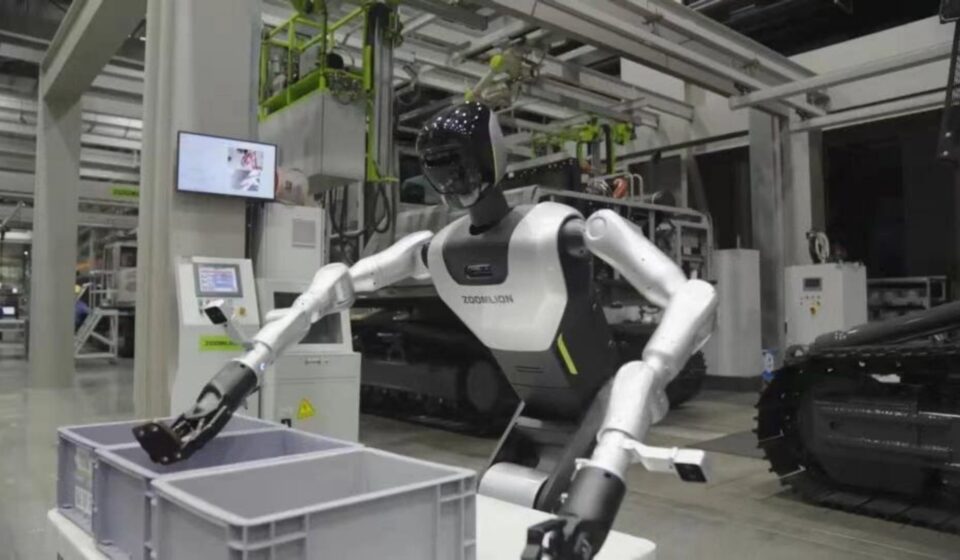
In 2024, Zoomlion expanded into humanoid robots, developing two-wheeled models and one bipedal unit, now piloted in machining, logistics, assembly, and quality inspection. These robots feature multimodal perception, intent recognition, integrated vision, force and tactile sensing, and dual-arm collaborative motion planning with safety awareness.
The company supports deployment with a training facility of over 100 workstations and an AI-native cloud platform for large-scale data collection and model training. Connected through Zoomlion’s industrial internet platform, which spans 1.7 million units of equipment worldwide, these systems enable real-time coordination and adaptive production. Looking forward, Zoomlion plans to advance robot clusters that can self-perceive, adapt, and make decisions within smart factory environments.