
Ecovacs Chooses a Lonelier but More Certain Path While Everyone Shoots Videos of Humanoid Robots
Table Of Content
The CES in 2026 was exceptionally bustling.
According to incomplete statistics, among the manufacturers related to humanoid robots participating in this CES, more than 21 are from China. Humanoid robots are starting to shift from being for show to practical use; more than 20 Chinese AI glasses manufacturers are participating, and multimodal interaction has become the mainstream. Jensen Huang, the CEO of NVIDIA, even proposed that “the ‘ChatGPT moment’ of physical AI is coming.”
After all, on a stage like CES, a sense of the future is often expressed at a low cost. But if we shift our focus from the “human – like” aspect and return to real life – what should be the first thing a robot does after entering thousands of households? The answer is definitely not those cool performance actions, but rather to truly take over those repetitive, boring tasks that humans are reluctant to do.
ECOVACS chose to answer this question in a low – key way: instead of betting on a “super robot” for its narrative, it presented a more realistic “family of household service robots” in the form of a Keynote Speech, bringing together floor – cleaning robots, window – cleaning robots, lawn – mowing robots, pool – cleaning robots, and the newly unveiled pet – companion robot under the same framework.
This alternative way of expression may not be as eye – catching, but it offers more certainty. Because it bypasses the competition of concepts and returns to the products, technologies, and scenarios themselves.
CES Scene and Brand Refresh: ECOVACS is Being Redefined
According to the observation of Yingke, this year’s CES features two ways of presenting robots: one focuses on the “form” and “concept” first and then depicts a grand future narrative; the other emphasizes “scenarios” and “delivery”, that is, it can solve one specific problem after another in life, and users can buy and use it smoothly.
ECOVACS clearly belongs to the latter.
In fact, Yingke also believes that the core of a brand may not lie in how many products are launched at once, but rather in “how to organize the product matrix”. From the on – site presentation, ECOVACS didn’t put any single product in the absolute spotlight. Instead, multiple product lines jointly form a map of “household service capabilities”: floor cleaning, window cleaning, lawn mowing, pool cleaning, and the exploration of emotional companionship. It aims to let users see not the leadership of a single popular product, but the accumulated robot capabilities of a powerful “intelligent” manufacturing enterprise in multiple household scenarios.
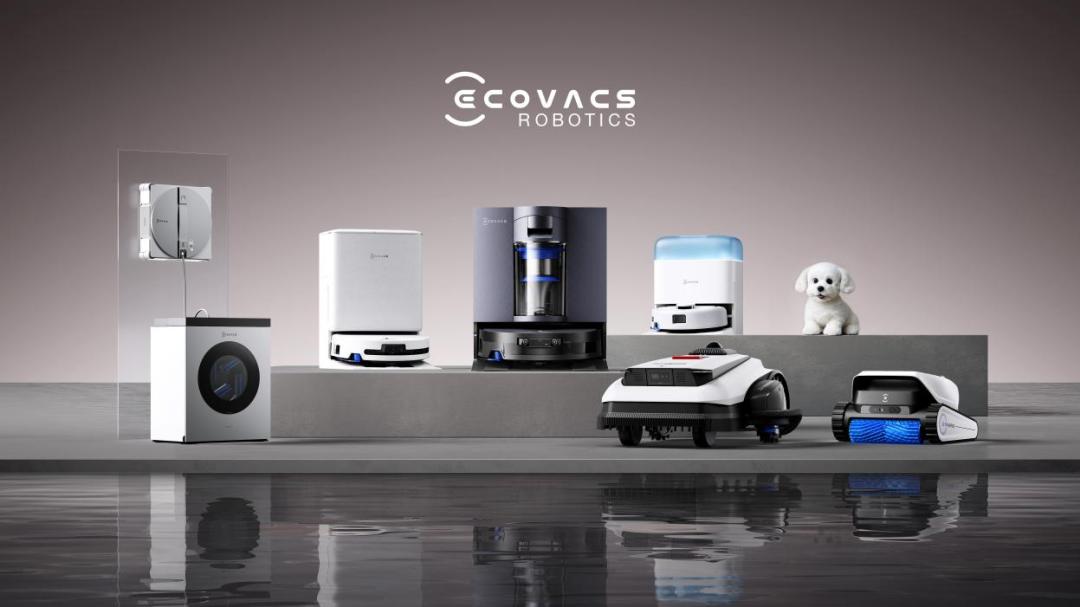
The lineup of ECOVACS robots on display at CES 2026
On – site, Qian Cheng, the vice – chairman of ECOVACS Group and the CEO of ECOVACS Robotics, used the word “comprehensive” to summarize this appearance: he hopes the outside world can see “a more comprehensive ECOVACS”, rather than just a floor – cleaning robot company.
Behind this statement, there is actually a larger background: in the past few years, the household robot market has been strongly defined by the “floor – cleaning robot”, which is the largest – scale and most competitive category. But when a category enters the mature stage, enterprises either continue to “compete to the extreme” in a single area or transfer their existing capabilities to more scenarios to build new growth and brand structures.
ECOVACS unhesitatingly chose the second path: from “cleaning” to “service”, from “single product” to “product family”.
This transformation is more intuitively reflected in the change of the brand idea. ECOVACS put forward a new brand concept “ECOVACS, Created for Ease”. It no longer emphasizes technical terms like “more intelligent and more advanced”, but focuses on a more realistic proposition: how to save consumers’ time and energy and even reduce the “difficulty” of life.
What makes this concept refreshing is that it is consistent with the product combination logic of ECOVACS at this CES: floor cleaning, window cleaning, lawn mowing, and pool cleaning are all “labors” that can be disassembled into fixed action combinations, which are very suitable for robots to perform and can save people a lot of time and energy.
From this perspective, “Created for Ease” aims to meet the actual experience expectations of users in different scenarios. In addition, for ECOVACS internally, “Created for Ease” is also a form of self – motivation and self – affirmation. After all, ECOVACS has sufficient technological capabilities, R & D strength, and judgment ability in this field to produce the best products and commercialize them.
Qian Cheng also mentioned a long – term judgment: robots will eventually become part of human society, but they don’t have to exist in the form of “human clones”. A more likely future is that robots will form “professional divisions” like social divisions of labor: different forms correspond to different tasks and achieve the highest efficiency in their respective scenarios. This is why, with the emergence of new categories like pool – cleaning robots and new “species” like pet – companion robots, the boundaries of household service robots will become wider and wider.
From Single Product to System: ECOVACS’ Technological Path and Product Logic
New concepts alone are definitely not enough to influence users. We still need to return to more hardcore products. In this exclusive interview, Yingke felt that Qian Cheng was particularly concerned about the most basic floor – cleaning robot on display at the CES – Deebot X12.
According to Qian Cheng, the significance of Deebot X12 is not just “a stronger next – generation product”. Instead, floor – cleaning robots are evolving from “automated household appliances” to products that are “more like robots”. The key difference between the two lies in whether they have a complete perception – judgment – execution closed – loop.
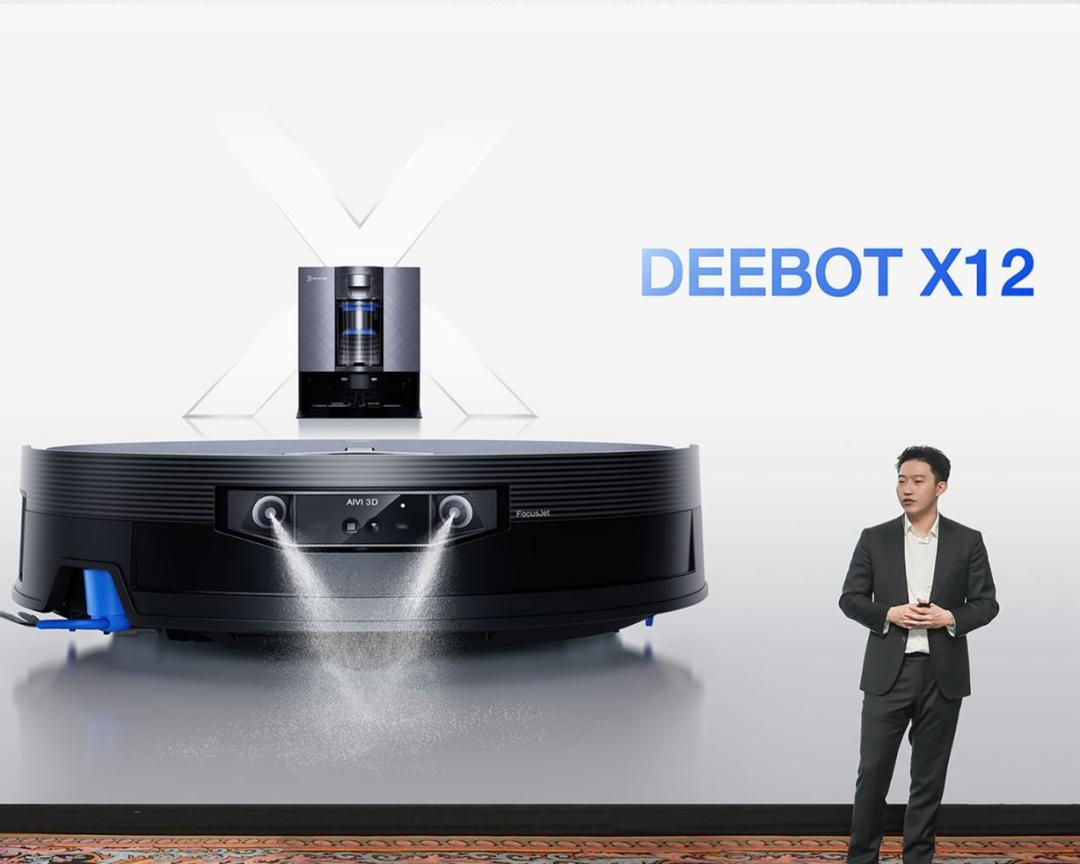
Qian Cheng, the CEO of ECOVACS Robotics, delivering a Keynote Speech at CES 2026
This closed – loop is reflected in Deebot X12 by a change in the way it understands “dirt”. Early floor – cleaning robots mainly focused on “moving smoothly and hitting less”, with the core being navigation, obstacle avoidance, and coverage efficiency. As consumers’ requirements for cleaning effects become higher and higher, robots must further solve two problems:
First, can they identify “where is dirtier and how dirty it is”; second, can they adopt different strategies for different types of dirt instead of using the same cleaning process throughout.
The product logic of Deebot X12 is centered around these two points: it uses the fusion of AI vision and sensors to identify the floor condition and the type of stains; the algorithm makes cleaning decisions based on the identification results; and then the high – pressure atomizing nozzle and the new OZMO ROLLER 3.0 constant – pressure live – water floor – cleaning technology complete the cleaning execution.
A key piece of information mentioned by Qian Cheng is that to improve cleaning efficiency and stability, the roller scheme has been strengthened in terms of length, structure, and cooperation mechanism. And these changes are not just single – point improvements but a whole – machine system engineering.
Although ECOVACS has sold 1.6 million roller – type floor – cleaning robots, Qian Cheng’s satisfaction doesn’t stop there. ECOVACS’ development path is not to rely on “a single selling point” but to transfer experience. The floor – mopping machine category has proven the long – term advantages of the roller scheme in cleaning efficiency and stability through practice, and floor – cleaning robots are evolving in this direction – consumers no longer just want the floor to be “swept”, but to be “as clean as if cleaned by hand”.
Qian Cheng said, “This is a path of accumulating engineering experience and market verification, not a path determined by theoretical deduction.” Behind this judgment is the engineer thinking of a hardware company regarding “technology selection”: short – term parameter differences may be caught up, but long – term experience differences will be reflected in word – of – mouth and repeat purchases.
More importantly, ECOVACS doesn’t just encapsulate these engineering capabilities in a single floor – cleaning robot. Instead, it uses them as “underlying capabilities” and transfers them to more scenarios.
This also explains why ECOVACS can cover so many robot categories. The answer doesn’t lie in “making more products and entering more scenarios”, but in whether the same set of capabilities can be repeatedly applied in different scenarios.
Overall, ECOVACS has summarized this ability reuse into a systematic path: the liquid – spraying, attaching, and path – control capabilities verified in window – cleaning robots can be transferred to local floor – cleaning; the edge – following, recognition, and path – planning capabilities verified in floor – cleaning robots can be transferred to scenarios like lawn mowing that also require “boundary processing”; sensor fusion, algorithm strategies, miniaturization of actuators, and improvement of stability can complement each other among different categories.
Therefore, having multiple categories is not “spreading the front line”, but rather the scenario – based application and iterative verification of the same set of robot capabilities. For consumers, a practical benefit of this system is that once they establish trust in one category of a company, the threshold for buying the next robot will be lowered – this is also one of the ways for household service robots to truly achieve large – scale adoption.
It’s Time for ECOVACS to Enter the “Embodied Era”
If we shift our focus from ECOVACS back to the robot market, we can more clearly see why ECOVACS has chosen a “more certain” path.
Because the household service robot market is a typical “slow – growing industry”. It is far from the light – asset expansion model of the Internet but a systematic project that emphasizes R & D, engineering, and the supply chain.
A robot with stable functions requires the joint establishment of sensors, structural components, actuators, algorithm control, overall machine reliability, and after – sales service systems; a robot that can be produced on a large scale also requires long – term coordination in manufacturing, cost control, and supply – chain resilience. Any shortcoming in any link will be magnified in a real – life household environment.
Qian Cheng attributes this to: technology must be productized, products must be scaled up, and finally be verified by consumers – this is the essence of business. This is also the reason why he repeatedly mentions “consumers voting with their money”: in the household scenario, concepts can attract attention once, but only experience can bring repeat purchases and long – term growth.
It is also under this decision that ECOVACS remains restrained in the face of the “concept – based, humanoid – oriented” craze: it doesn’t deny the direction of embodied intelligence, but emphasizes “scenario priority”. In Qian Cheng’s view, robots will not have only one form in the future. Instead of concentrating all capabilities on a general – purpose humanoid robot, it is better to let robots continuously specialize in specific scenarios – achieving higher efficiency and reliability in clear tasks such as floor cleaning, window cleaning, lawn mowing, and pool cleaning.
This is also ECOVACS’ another understanding of the embodied era: embodiment does not equal humanoid. Embodiment can be a system of capabilities – perceiving the world, understanding tasks, executing actions, and iterating through feedback. As long as this set of capabilities continuously evolves in real scenarios, it is in the state of “embodiment”.
The ECOVACS pet – companion robot, which made its debut at the CES, provides such an observation perspective. It doesn’t focus on efficiency but on “emotional value” and “interaction relationship”. Based on a large – scale model and a vast amount of Maltese dog data, this robot clones real – world pet dogs into intelligent agents. It can understand human language and emotions and interacts with people in a dog – like interaction way that provides a sense of distance and security.
Qian Cheng divides the evolution of robots into three stages: tool – type, housekeeper – type, and companion – type. The pet – companion robot is more like an exploration of the third stage: when a robot not only completes tasks but also becomes part of family life, the capabilities it needs are no longer just cleaning effects but more complex interaction, feedback, and a sense of “companionship”.

Qian Cheng, the CEO of ECOVACS Robotics, delivering a Keynote Speech at CES 2026
But ECOVACS remains restrained in this kind of exploration: embodiment is more like a directional signal rather than a replacement for the current business focus. That’s why it is more clearly distinguished from the “concept – first” narrative – exploration can exist, but large – scale verification must return to products, technologies, and scenarios.
First, solve problems in a down – to – earth way, and then clarify the future. The real challenge is to break down the future into deliverable products that can withstand daily use in real households.
The path chosen by ECOVACS may not be very flashy: it doesn’t use humanoid robots to create the strongest imagination, nor does it bet its narrative on a single “all – powerful robot”. Instead, it uses a combination of service robots in multiple categories and scenarios to answer a more realistic question – how robots should enter family life.
At least at the current stage, the answer it provides is: let robots first take over those things that humans are reluctant to do but that occur repeatedly; let technology first achieve productization and large – scale production; and let “consumers voting with their money” be the ultimate test standard.
In this sense, this path may be lonely, but it is more certain.