
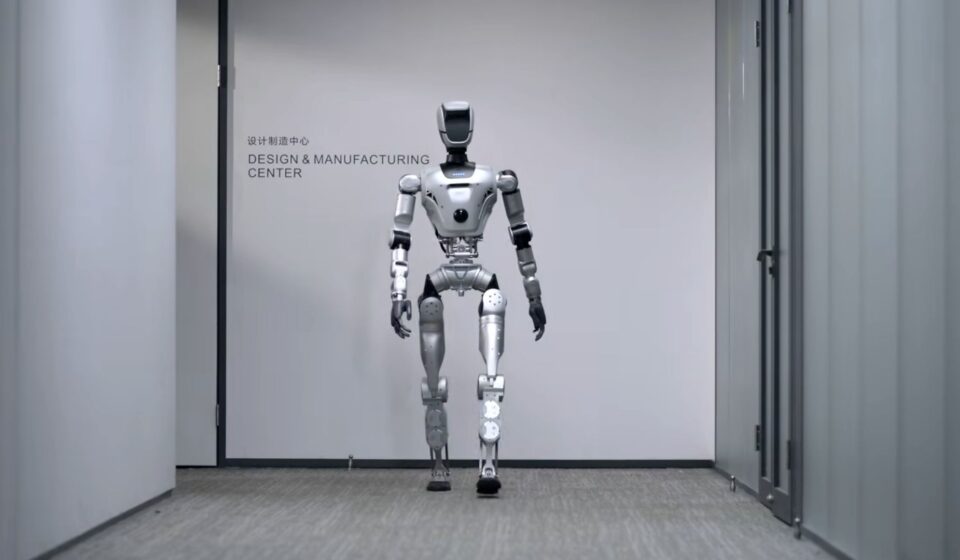
Chinese robotics player LimX Dynamics has unveiled LimX COSA, an operating system designed for humanoid robots operating in real-world environments.
COSA stands for Cognitive OS of Agents and is intended to enable robots to perceive, reason, and move without continuous human supervision.
The Shenzhen-based company describes it as the first operating system built exclusively for embodied agents—robots that function in the same physical spaces as humans—rather than for simulations or controlled laboratory settings.
LimX claims the system supports autonomous interaction with complex, real-world surroundings.
In December 2025, LimX Dynamics released a new video showing its humanoid robot Oli maintaining balance while crossing sand, rocks, boards, and debris.
Robots act independently
LimX Dynamics has designed COSA around its full-size humanoid robot, Oli, which stands about 5 feet 5 inches tall and features 31 joints for whole-body movement.
Demonstrations show Oli receiving spoken instructions—such as delivering two bottles of water to a front desk—and independently determining how to complete the task.
The robot identifies the objective, plans a route, navigates through its environment, grasps the required objects, and delivers them, all without predefined paths, teleoperation, or human supervision. Its actions are generated and adjusted in real time as conditions change, reports Techeblog.
COSA functions as a central operating system linking humanoid robots directly to the physical world through an agent-based design. The system is structured in three distinct layers. The foundational layer focuses on robust whole-body motion control, enabling balance, smooth locomotion, and traversal of uneven terrain, including stairs.
Above this, the skill and perception layer allows the robot to sense its surroundings, recognize objects, navigate spaces, and manipulate items while in motion. The top layer handles cognition, translating natural language into executable tasks, planning strategies, making decisions, and dynamically adapting behavior, reports Pan Daily.
Together, these layers integrate perception, language, and action with full-body control, forming a unified architecture that supports autonomous reasoning and task execution in real-world environments, reports Techeblog.
Brain-like robot OS
LimX Dynamics designed COSA to mirror the functional structure of the human brain by tightly integrating cognition and physical action within a single operating system. The system links high-level reasoning with low-level motion so closely that planning and movement occur almost simultaneously.
COSA also incorporates memory, enabling the robot to recall previously observed environments and objects and use that information to anticipate future actions, reports Techeblog.
When the humanoid robot Oli performs tasks such as climbing stairs, onboard sensors continuously feed real-time data into the system, allowing immediate adjustments to balance and gait.
This close coupling between perception, decision-making, and motion addresses a common limitation of conventional robots, where isolated modules handle separate functions and often fail when conditions change unpredictably.
COSA instead unifies models, skills, memory, and basic emotional states that can influence behavior over time, creating an operating system optimized for sustained physical interaction with the real world.
According to Pan Daily, powered by COSA, Oli has demonstrated several core capabilities. It can understand complex spoken instructions, autonomously plan and execute multi-step tasks, perceive its surroundings using semantic memory, and perform smooth locomotion based on live sensory input.
The introduction of COSA is viewed as an important milestone for embodied intelligence, highlighting a transition from isolated technical demonstrations toward integrated operating systems focused on real-world deployment, usability, and autonomous performance by humanoid robots.