
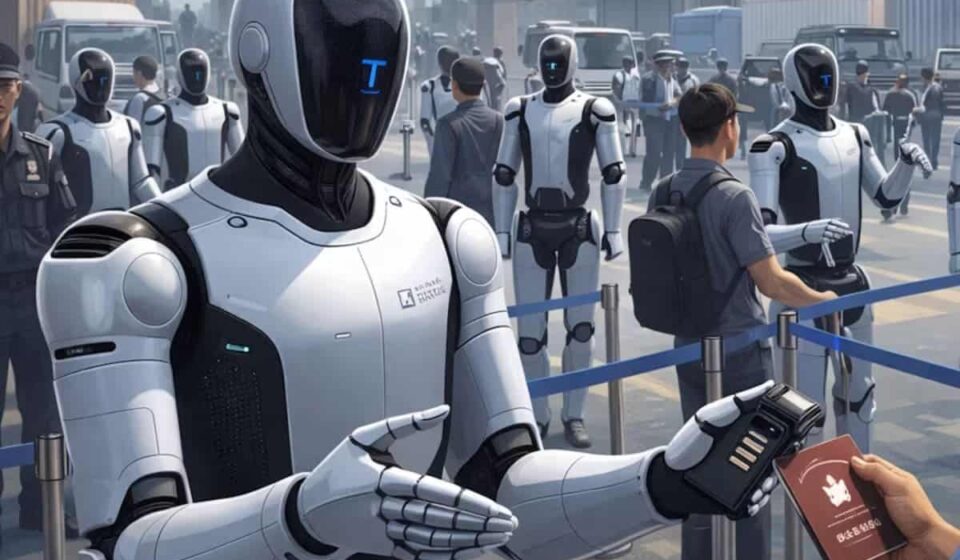
A Chinese city on the Vietnamese frontier is turning to robots to keep the border crossing moving and to support human guards.
Fangchenggang, a coastal hub in Guangxi, sits right beside Vietnam. Each day brings a steady flow of cargo trucks, buses, and day travelers. For Chinese customs officers, keeping traffic smooth while inspecting both freight and people has long been a logistical headache.
To ease the bottleneck, officers will now be backed up by humanoid machines. The models—Ubtech Robotics’ Walker S2—are adult-sized, able to walk, handle objects, and interact with their surroundings using built-in sensors, cameras, and onboard AI. The authorities haven’t disclosed how many units are coming, but the contract with Ubtech is valued at 37 million euros, and deliveries are already underway.
These robots will take on “operational” duties: regulating flows, guiding queues, answering basic questions, issuing instructions, and patrolling waiting halls and transit corridors. Additional units will circulate through freight zones, inspecting containers and feeding data to command centers.
The decisive crash test
For Ubtech, this rollout is a pivotal trial. If travelers see clear benefits—and if border guards can spend less time on crowd control and repetitive guidance—the initiative will be judged a success.
Officials argue that if the machines perform in a setting as demanding as a border post, they could later be extended to airports, train stations, and ports. Still, some users may feel uneasy being managed and watched by machines. And for the guards, thorny questions remain about training, authority, and responsibility when a robot gets it wrong.
A failure by these mechanical sentinels would be a serious setback for Ubtech, likely slowing the spread of humanoids in sensitive public spaces. Can China accept that outcome, given how strongly it promotes—and invests in—this technology?

Sylvain Biget
Journalist
From journalism to tech expertise
Sylvain Biget is a journalist driven by a fascination for technological progress and the digital world’s impact on society. A graduate of the École Supérieure de Journalisme de Paris, he quickly steered his career toward media outlets specializing in high-tech. Holder of a private-pilot licence and certified professional drone operator, he blends his passion for aviation with deep expertise in tech reporting.
A key member of Futura’s editorial team
As a technology journalist and editor at Futura, Sylvain covers a wide spectrum of topics—cybersecurity, the rise of electric vehicles, drones, space science and emerging technologies. Every day he strives to keep Futura’s readers up to date on current tech developments and to explore the many facets of tomorrow’s world. His keen interest in the advent of artificial intelligence enables him to cast a distinctive light on the challenges of this technological revolution.