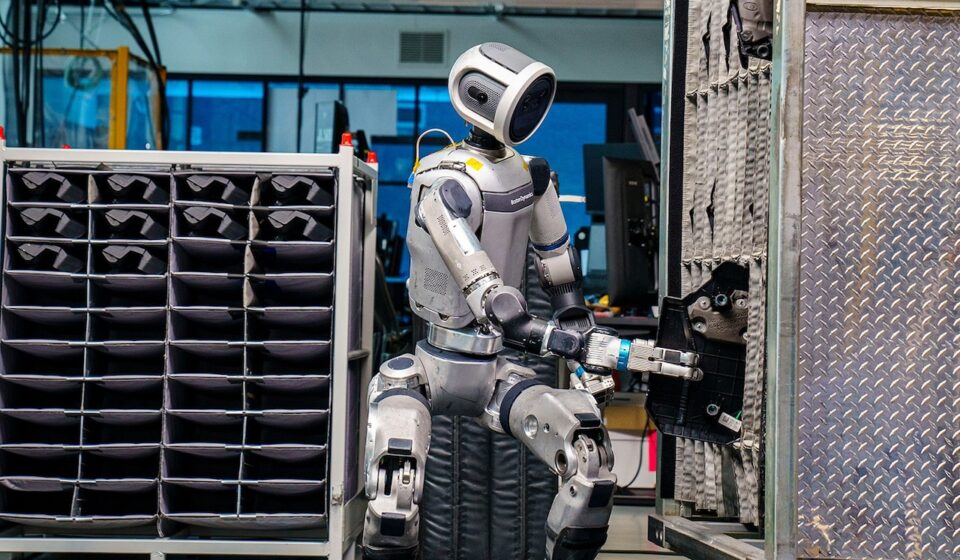
Waltham-based Boston Dynamics said that its Atlas robot will be deployed in Hyundai car factories, starting in 2028. One initial task the robot will take on is called “parts sequencing” — organizing the parts required for the assembly line in a mobile carrier. Courtesy Boston Dynamics
At the Consumer Electronics Show in Las Vegas earlier this month, Boston Dynamics was showing off the latest version of its humanoid robot, Atlas. Even though this latest version of Atlas has already starred in YouTube videos that have racked up millions of views, this was the machine’s first public outing, and every time it waved from the stage, the audience broke into applause.
A few weeks earlier, a job opening appeared that could offer a hint about what comes next for the Waltham company, which is owned by the South Korean car maker Hyundai Motor Group.
Boston Dynamics has had several owners since it was founded in 1992, including Google and the Japanese investment firm SoftBank, but the December job post suggests that Hyundai might be thinking about bringing in additional investors — or perhaps taking Boston Dynamics public.
The company is hiring an investor relations manager to “manage future funding rounds and market positioning” and “begin establishing foundational relationships with potential new investors … and investment banks …”
The job description “reads like prep for a spin-out to me,” said Paul Bowen, a Boston investment banker, referring to a transaction that would bring in new investors, perhaps with an eye toward an eventual IPO.
Former employee Martin Walsh wrote via email that Boston Dynamics Chief Executive Robert Playter “has wanted to go public at some point, but that was always in the distant future.”
Bruce Welty, an entrepreneur in the robotics industry, said that “with all the excitement around humanoids and all the capital flowing … I imagine it’s just their executive leadership team saying, ‘Hey, cheap money (is available), let’s see if we can get some.’”
In recent years, several other companies working on humanoid robots have touted their progress — and raised hundreds of millions in funding. Silicon Valley-based Figure raised $1 billion last fall, bringing its valuation to $39 billion. And other companies — such as Oregon-based Agility Robotics, Humanoid, headquartered in the UK, and carmaker Tesla, with its Optimus robot — are attracting millions and generating plenty of hype.
In China, Unitree Robotics is reportedly planning an IPO. Unlike many of its competitors — including Boston Dynamics — Unitree is already selling humanoid robots. (Boston Dynamics does sell its dog-like robot, Spot, and a robot arm for warehouse work, Stretch.)
But there are questions about whether “do it all” humanoid robots will be more successful, in the near-term, at getting work done than robots designed for a single purpose like clearing snow or vacuuming floors.
Boston Dynamics has been working on Atlas for longer than many of its competitors have been in existence. Atlas started life as a project for the Department of Defense in 2013; it evolved from having hydraulic-powered joints to electrical ones in 2024. While Boston Dynamics said at the Consumer Electronics Show this month that Atlas would be deployed in a Hyundai factory in 2028, it didn’t divulge any details about pricing or general availability.
The current version of Atlas is 6-foot, 2 inches, can lift up to 110 pounds, and runs for four hours on a battery charge. (It can also change its own battery.)
In 2021, when Hyundai bought a majority stake in Boston Dynamics for about $880 million, the deal valued it at $1.1 billion. (Former owner SoftBank held onto 20 percent of the company.) That valuation would likely be far more in 2026.
If Boston Dynamics were to go public, Welty said, “it will be a big deal, no matter what happens. If it is a hugely successful IPO, it will be great for the aspiring humanoid companies. If it receives tepid support that will say, well, maybe humanoids are not the best way forward.”
Neither Boston Dynamics nor Hyundai responded to requests for comment.