Table Of Content

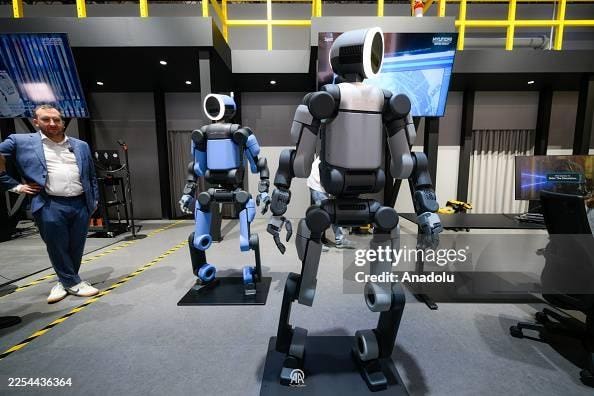
LAS VEGAS, NEVADA – JANUARY 6: A view of Boston Dynamics Atlas robots at the CES (Consumer Electronic Show) 2026, the world’s largest annual consumer technology trade on January 6, 2026 at the Las Vegas Convention Center in Las Vegas, Nevada, United States. (Photo by Tayfun Coskun/Anadolu via Getty Images)
Anadolu via Getty Images
Boston Dynamics Just Beat Tesla to the Factory Floor. Here’s Why Investors Should Watch the Parts, Not the Robot.
At CES 2026 two weeks ago, a robot walked onto a Las Vegas stage, waved to the crowd, then did something no human ever could: its torso spun 180 degrees while its legs stayed planted, knees bending backward as it walked away. The audience didn’t applaud a trick. They witnessed a product launch.
Boston Dynamics’ Atlas is no longer a research project. It’s now in production, with all 2026 units already committed to Hyundai factories and Google DeepMind. CNET Group named it “Best Robot” at CES, with judges noting that the “product version is ready to be deployed into Hyundai manufacturing facilities from this year, where it might just be working on your next car.”
Why This Robot Is Different
Most humanoid robots try to mimic humans. Atlas improves on them.
The specs tell the story: 6.2 feet tall, 198 pounds, with a 7.5 foot reach when arms are extended. It can instantly lift 110 pounds and sustain 66 pounds for continuous work. Its 56 degrees of freedom allow complete rotation at the head, torso, hands, and fingers, meaning it can interact with objects more efficiently than any person. No wasted motion turning around. No physical constraints inherited from human anatomy.
The robot operates on dual battery packs providing about four hours of runtime. When power runs low, it doesn’t stop for a human to swap batteries. It autonomously navigates to a charging station, replaces the packs in three minutes, and returns to work. Boston Dynamics says recharging takes 90 minutes, meaning Atlas can operate around the clock with minimal downtime.
It’s also the first humanoid certified for shared workspaces. The 360 degree camera system detects approaching humans and automatically pauses. The design includes padding and minimal pinch points. Boston Dynamics calls it “enterprise grade,” a phrase you don’t use for science experiments.
The Software Advantage Nobody’s Talking About
At CES, Boston Dynamics announced a partnership with Google DeepMind that changes the competitive landscape.
DeepMind will integrate its Gemini Robotics AI foundation models into Atlas, giving the robot what Carolina Parada, senior director of robotics at DeepMind, called the ability to “understand the physical world the same way we do.” Rather than programming specific tasks, Atlas will learn from demonstrations and generalize to new situations.
The implication for fleet deployment is profound. Boston Dynamics’ Orbit software already allows one Atlas to share learned skills with every other unit in a company’s fleet. If a robot in the lab masters a new assembly task overnight, every unit on the factory floor knows it by morning. The DeepMind partnership accelerates this, with Parada noting that Atlas could learn new industrial workflows from as few as 50 human demonstrations.
This is the Tesla Full Self Driving model applied to physical labor. When one car learns to navigate a new obstacle, the entire fleet gets the update. Atlas works the same way. The difference is Boston Dynamics is shipping now, while Tesla’s Optimus remains in internal testing with no confirmed external customers.
The iPhone Parallel Is Real
Think back to the first iPhone in 2007. The multitouch display seemed like a gadget until you realized it eliminated the need for physical buttons entirely. The interface wasn’t incremental. It was architectural.
Atlas represents a similar shift for industrial labor. The robot isn’t designed to replace one worker. It’s designed to eliminate the physical constraints that define human work: fatigue, injury risk, temperature sensitivity, the need for breaks.
Atlas operates between minus 4 and 104 degrees Fahrenheit at full capacity. It’s IP67 rated, meaning fully water resistant. It integrates directly with existing Manufacturing Execution Systems and Warehouse Management Systems through Orbit. Boston Dynamics says most tasks can be trained in under a day.
Hyundai plans to deploy Atlas at its Metaplant America facility in Savannah, Georgia by 2028, starting with parts sequencing. By 2030, applications will extend to component assembly and tasks involving repetitive motions and heavy loads. The company also announced plans to build a robotics factory capable of producing 30,000 units annually.
The Real Investment Thesis
Here’s what most observers miss: the robot itself may not be the best investment.
The humanoid market is crowded. Tesla, Figure AI, Agility Robotics, Unitree, and at least a dozen others are building competing platforms. Prices range from Tesla’s projected $20,000 to $30,000 at scale to over $250,000 for industrial units. Margins will compress as production scales.
The bottleneck play is different. Every humanoid robot, regardless of manufacturer, needs the same core components: advanced sensors for perception, high performance actuators for movement, and edge AI chips for real time processing. These supply chains are constrained.
For the “eyes and brains,” consider companies like Ambarella, which makes the edge AI vision processors that enable robots to perceive their environment in real time. Ouster provides the lidar systems that create 3D spatial awareness. Sony supplies the high resolution image sensors that feed the AI systems.
For the “muscles,” Harmonic Drive makes the precision gearing systems that enable smooth, high torque movement in robotic joints. Moog and Parker Hannifin produce the advanced actuators and motion control systems that translate AI commands into physical action. Hyundai Mobis, which Boston Dynamics announced will supply actuators for Atlas, is another supply chain play.
The component suppliers have structural advantages that robot makers don’t: diversified customer bases across multiple industries, established manufacturing scale, and technology moats that take years to develop. They win regardless of which humanoid platform dominates.
The Bottom Line
Atlas isn’t a prototype anymore. It’s a product with committed customers, a Google DeepMind partnership, and a deployment timeline measured in months, not years.
The shift from demonstration to deployment is the story of CES 2026. But for investors, the better opportunity may not be the robots themselves. It’s the companies building the eyes, brains, and muscles that every humanoid needs to move.
If you liked this, you’ll love the daily dose we send to our Substack crew. It’s chill, it’s sharp, and it actually helps. Hop on here.
Sources
- Boston Dynamics Atlas CES 2026 unveiling and production announcement — Boston Dynamics Blog, January 5, 2026 https://bostondynamics.com/blog/boston-dynamics-unveils-new-atlas-robot-to-revolutionize-industry/
- Atlas wins “Best Robot” at Best of CES 2026 Awards by CNET Group — Hyundai Motor Group, January 9, 2026 https://www.hyundai.com/worldwide/en/newsroom/detail/0000001105
- Atlas specifications: 6.2 feet, 198 pounds, 110 lb instant lift, 56 degrees of freedom — Boston Dynamics product page https://bostondynamics.com/products/atlas/
- Dual battery system, 4 hour runtime, 3 minute swap, 90 minute recharge — BGR, January 2026 https://www.bgr.com/2071680/hyundai-reveal-next-gen-robot-boston-dynamics-robot-atlas/
- 360 degree vision, 360 degree rotation at joints — BGR, January 2026 https://www.bgr.com/2071680/hyundai-reveal-next-gen-robot-boston-dynamics-robot-atlas/
- Google DeepMind partnership and Gemini Robotics integration — Boston Dynamics Blog, January 5, 2026 https://bostondynamics.com/blog/boston-dynamics-google-deepmind-form-new-ai-partnership/
- Carolina Parada quote on robots learning from 50 demonstrations — The Robot Report, January 2026 https://www.therobotreport.com/boston-dynamics-google-reunite-on-next-gen-atlas-humanoid/
- Orbit fleet management and task replication — Boston Dynamics Enterprise page https://bostondynamics.com/blog/enterprise-robotics-redefined/
- Hyundai Metaplant America deployment 2028, assembly by 2030 — NBC News, January 5, 2026 https://www.nbcnews.com/tech/tech-news/hyundai-boston-dynamics-unveil-humanoid-robot-atlas-ces-rcna252483
- 30,000 unit annual production capacity planned — The Register, January 6, 2026 https://www.theregister.com/2026/01/06/boston_dynamics_atlas_production/
- Tesla Optimus no external customers, behind schedule — The Register, January 6, 2026 https://www.theregister.com/2026/01/06/boston_dynamics_atlas_production/
- Hyundai Mobis supplying actuators for Atlas — Boston Dynamics Blog, January 5, 2026 https://bostondynamics.com/blog/boston-dynamics-unveils-new-atlas-robot-to-revolutionize-industry/
- Component supplier investment thesis: Ambarella, Harmonic Drive, Qualcomm — InvestorPlace, January 2026 https://investorplace.com/hypergrowthinvesting/2026/01/humanoid-robot-stocks-ces-2026-reveals-commercial-breakout/