
![Workers inspect a vehicle on the production line for the Ioniq 5 EV at Hyundai Motor’s Ulsan plant. [HYUNDAI MOTOR]](https://koreajoongangdaily.joins.com/data/photo/2026/01/20/da987722-087a-4165-b90c-56cbd2513728.jpg)
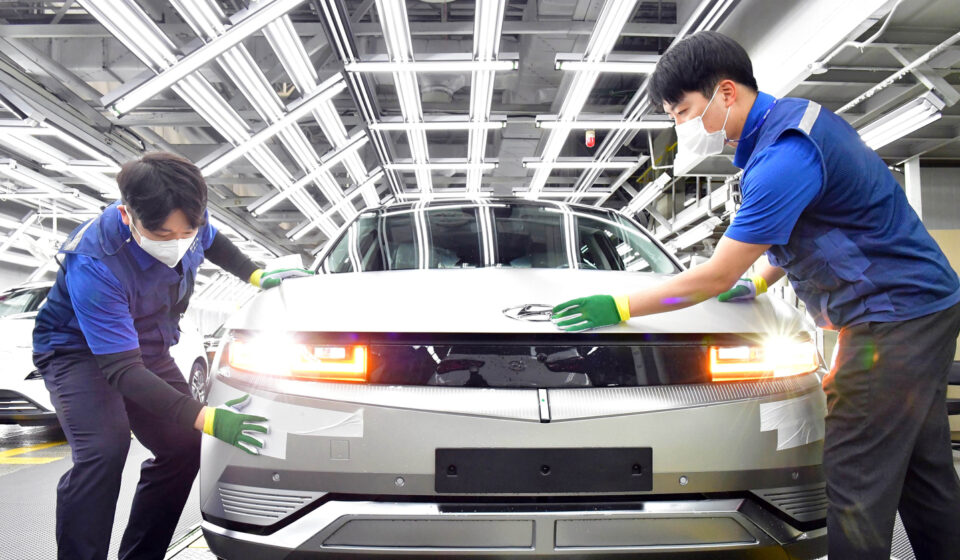
Workers inspect a vehicle on the production line for the Ioniq 5 EV at Hyundai Motor’s Ulsan plant. [HYUNDAI MOTOR]
As Hyundai Motor Group pushes ahead with humanoid robots designed to work around the clock, promising higher productivity and profits, factory workers worry that automation may soon reach even the most hands-on roles on the assembly line.
The unease is already personal for some workers. One Hyundai Motor production employee said watching footage of Atlas stirred mixed emotions, raising doubts about whether jobs expected to last until retirement will endure.
Robots and automated machines already handle quality inspections and parts transfers inside Hyundai plants, the worker noted. But final assembly — work that requires maneuvering engines into place or fitting transmissions in tight spaces — had long been considered the last stronghold of human labor.
“I thought those processes were something only humans could do, but now it feels like even that can be replaced,” the worker said. “I suppose I should say I’m lucky I only have five years left until retirement. Luckily, I’m leaving as things are, but I worry about what lies ahead for the younger workers.”
![Atlas demonstrates moving auto parts at the Hyundai Motor Group exhibition booth at CES 2026 in Las Vegas on Jan. 18. [HYUNDAI MOTOR GROUP]](https://koreajoongangdaily.joins.com/data/photo/2026/01/20/078a74b4-0774-48d7-8407-16583aa86e6a.jpg)
Atlas demonstrates moving auto parts at the Hyundai Motor Group exhibition booth at CES 2026 in Las Vegas on Jan. 18. [HYUNDAI MOTOR GROUP]
Hyundai Motor Group showcased Atlas earlier this month at CES in the United States, where the robot won a top award in robotics. The announcement fueled investor optimism that humanoid robots could significantly improve industrial productivity, sending Hyundai Motor’s share price higher.
Atlas is designed to move more freely than traditional industrial robots, with joints that can rotate in multiple directions. Hyundai says the robot can learn most tasks in less than a day. When its battery runs low, it can navigate to a charging station on its own, swap batteries and return to work — enabling production lines to run continuously.
The company plans to deploy Atlas starting in 2028 at Hyundai Motor Group Metaplant America in Georgia, initially assigning it to parts-sorting tasks. By 2030, Hyundai expects to expand its role to assembly and other manufacturing processes.
Hyundai executives argue that the robot will take on “repetitive, heavy and hazardous work, allowing human workers to move into safer, higher-value roles.” On the factory floor, however, the promise rings hollow for some employees.
“The labor office has received a growing number of calls from workers asking whether the union should oppose the robot rollout,” a union official at a Hyundai Motor Group affiliate said.
![An interior view of Kia Autoland Gwangmyeong in Gwangmyeong, Gyeonggi. The plant, which began operations in 1973 as Korea’s first fully integrated automobile factory using a conveyor belt system, has since been transformed into a facility where robotic arms, including collaborative robots, carry out assembly work. [KO SUK-HYUN]](https://koreajoongangdaily.joins.com/data/photo/2026/01/20/359b820e-d59c-4c67-90c6-a20ad45fd840.jpg)
An interior view of Kia Autoland Gwangmyeong in Gwangmyeong, Gyeonggi. The plant, which began operations in 1973 as Korea’s first fully integrated automobile factory using a conveyor belt system, has since been transformed into a facility where robotic arms, including collaborative robots, carry out assembly work. [KO SUK-HYUN]
Hyundai does not release detailed factory productivity data. But estimates based on vehicle output and employee headcount in regulatory filings suggest that production workers at Korean plants build about 44 vehicles per year, compared to 84 vehicles per worker at Hyundai Motor’s U.S. plants. With Atlas scheduled for deployment in the United States first, many workers see its eventual arrival in Korea as unavoidable.
Kim Gui-yeon, an analyst at Daishin Securities, said the financial incentives behind humanoid robots are hard for automakers to ignore.
“Labor costs at Hyundai Motor Group’s major listed affiliates average about 130 million won [$88,200] per worker annually, while maintaining a humanoid robot costs around 14 million won a year,” Kim said. “Even replacing just 10 percent of production workers with humanoids could improve annual profits by about 1.7 trillion won. Humans work eight hours. Robots can work 18. Even after accounting for capital spending and infrastructure, the gains are clear.”
Hyundai Motor’s move reflects a broader shift across the global auto industry. Tesla plans to begin using its humanoid robot, Optimus, in factories this year after completing pilot tests. BMW and Mercedes-Benz introduced humanoid robots from Figure AI and Apptronik, respectively, into their production lines in 2024.
The unease extends well beyond automaking. Heavy industries such as shipbuilding and steel — including HD Hyundai Heavy Industries, Hanwha Ocean and Posco — are accelerating the adoption of physical AI. Logistics companies like CJ Logistics are also moving quickly. While robots currently handle high-risk tasks such as ship welding and furnace control, many workers believe it is only a matter of time before machines encroach further into human roles.
![CJ Logistics showcases advanced logistics services, including dual-arm robots, at a logistics industry exhibition at Kintex in Goyang, Gyeonggi, on April 22, 2025. [YONHAP]](https://koreajoongangdaily.joins.com/data/photo/2026/01/20/cde6dd06-6053-465b-bea2-538769151892.jpg)
CJ Logistics showcases advanced logistics services, including dual-arm robots, at a logistics industry exhibition at Kintex in Goyang, Gyeonggi, on April 22, 2025. [YONHAP]
Labor unions say they are not categorically opposed to automation. A union official at a Hyundai affiliate acknowledged that the trend is difficult to resist.
“If robots handle dangerous or unpopular tasks, they can help protect workers’ health,” the worker said. “But issues like extending the retirement age and hiring new workers remain unresolved. Management and labor need to discuss how fast this transition should move if jobs are to be protected.”
Ahn Kyu-baek, head of the Korea GM labor union, noted that automation has already reshaped much of the auto industry.
“More than 90 percent of welding work is already done by machines,” Ahn said. “Only processes that truly require human involvement remain. We need to watch carefully how quickly AI and robots advance. A full industrial transition will require safeguards.”
Some experts argue that humanoid robots could ultimately open new opportunities for both companies and workers. Kim Ki-chan, a professor emeritus of business administration at the Catholic University of Korea and a former outside director at Hyundai Mobis, pointed to earlier technological shifts at the conglomerate.
“In the 2000s, Hyundai Motor Group moved away from an analog system of controlling each part individually and adopted a digital modular approach. That change helped it catch up with Toyota on quality,” Kim said. “Physical AI does not automatically destroy jobs. It changes how people work. Instead of focusing only on wages, unions should negotiate over working methods and use this transition as a chance to grow.”
This article was originally written in Korean and translated by a bilingual reporter with the help of generative AI tools. It was then edited by a native English-speaking editor. All AI-assisted translations are reviewed and refined by our newsroom.
BY KO SUK-HYUN [[email protected]]